

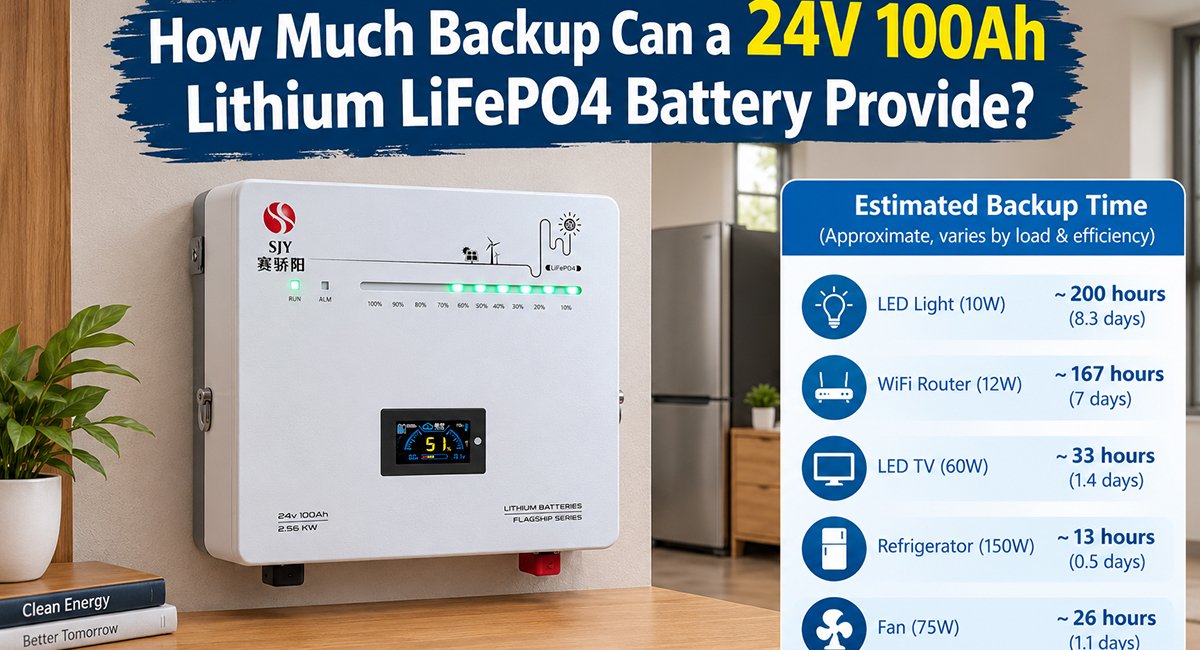
How Much Backup Can a 24V 100Ah Lithium Battery Provide? Leave a comment
You find yourself looking at a technical specification sheet, trying to figure out if a 24V 100Ah Lithium Battery will last through all the blackouts you go through, or whether you are buying yourself into spending money on a device that fails after an hour of power shedding. That is a valid concern, and the truth of the matter is, there is much more to consider than just that number on the spec sheet.
Let’s examine what the 24V 100Ah Lithium Battery truly delivers and how that number varies in real use.
What The Numbers Actually Tell You
A 24V 100Ah Lithium Battery has an energy storage capacity of approximately 2.4 kilowatt-hours. The calculation of the energy storage capacity can be done using the product of the voltage times the amp-hours, which would be the total energy that the battery can deliver from being fully charged up to being fully discharged. But chances are you will not fully discharge the battery.
Here’s the part most people skip: 2.4 kWh doesn’t mean anything on its own until you know what you’re powering. A house running a few LED bulbs and a fan draws a fraction of a kilowatt. A house running a refrigerator, a router, and a couple of fans draws several times more. The same 24V 100Ah Lithium Battery gives you very different backup times depending on which of these you’re running.
Working Out Roughly How Long It Lasts
To find out the time you can run a particular system using a battery as an energy source, you need to divide the battery watt-hours by its load in watts. Thus, when you have a 2.4 kWh battery running a 200-watt load, you can expect to run your system for about 12 hours under the best circumstances. At 500 watts, it goes down to 4 or 5 hours.
This is exactly why the same 24V 100Ah Lithium Battery gets completely different reviews from different buyers. Someone running a light load during short outages will say it lasts most of the night. Someone running an air conditioner or a water pump on the same battery will say it drains in under an hour. Both are telling the truth about their own setup.
How Lithium Batteries Help You Make Best Use Of Your Investment
One way that a 24V 100Ah Lithium Battery beats the lead-acid battery that matches it in terms of rated capacity is usability. The lithium battery technology, specifically the LiFePO4 variety, performs excellently in deep and frequent discharges compared to the lead-acid batteries. This helps the user utilize much more of the rated capacity of the lithium battery without impacting its lifespan in a major way. The 100Ah rating in lead-acid batteries means that you only get comfortable use of about half of the rated capacity.
This is one reason why a 24V 100Ah Lithium Battery usually performs better than a lead-acid battery with the same amp-hour rating on the label.
Watching A Real Backup Test Tells You More Than Math
Numbers on paper only go so far. Seeing an actual 24V 100A wall-mounted lithium battery running under real load gives you a much clearer picture of how backup time plays out in practice. This video walks through a real backup test on a wall-mounted lithium battery and is worth watching before you commit to a capacity.
Where Pakistan’s Grid Conditions Change The Picture
While buying a 24V 100Ah Lithium Battery to cope with daily load shedding, your battery is definitely not used in the same way as when in laboratory conditions, where a battery is used occasionally. Continuous charging and discharging cycles due to frequent load shedding will stress the battery during its life cycle much more than using it only once in a while as a backup. Grid voltage fluctuations might influence the charging cycle of your battery in between load shedding periods.
Summer heat adds another layer. A battery room that gets hot during the day can push the battery’s internal protection systems to behave more conservatively, which can shave a bit off your expected runtime compared to cooler conditions. None of this makes the battery defective; it’s simply the difference between a spec sheet and your actual rooftop or storeroom.
The Battery and Your Loads
It is recommended that before purchasing the battery, you calculate the wattage of all the devices you will operate during a power outage instead of making assumptions. If you plan to operate lighting, fans, a router, and a little television, they could require somewhere between 150 and 300 watts of energy, which can be easily provided by a 24V 100Ah Lithium Battery. If you include a fridge or air conditioning in this list, your expected runtime will significantly decrease because these devices consume more energy.
Should you experience outages that frequently exceed the capabilities of your 24V 100Ah Lithium Battery, the more sensible idea would be for you to run the battery in conjunction with another in parallel as opposed to relying on it to function beyond its limits.
Getting A Straight Answer For Your Specific Setup
Working out real backup time before you buy saves you from disappointment after you’ve already installed the battery. If you’re not sure how a 24V 100Ah Lithium Battery will perform against your actual household or shop load, it’s worth getting a second opinion rather than guessing from a product description. Maaz Electronics has worked directly in Pakistan’s electronics and power-systems market for over 9 years, dealing with exactly these kinds of practical battery-sizing questions for homes and small businesses facing real load shedding conditions.
A 24V 100Ah Lithium Battery can genuinely carry you through several hours of backup, but only when you match its capacity honestly against what you’re actually powering. Do that math before you buy, and the battery will do exactly what you expect it to. For business inquiries, reach out at 𝐦𝐚𝐚𝐳𝐞𝐥𝐞𝐜𝐭𝐫𝐨𝐧𝐢𝐤𝐬@𝐠𝐦𝐚𝐢𝐥.𝐜𝐨𝐦
