

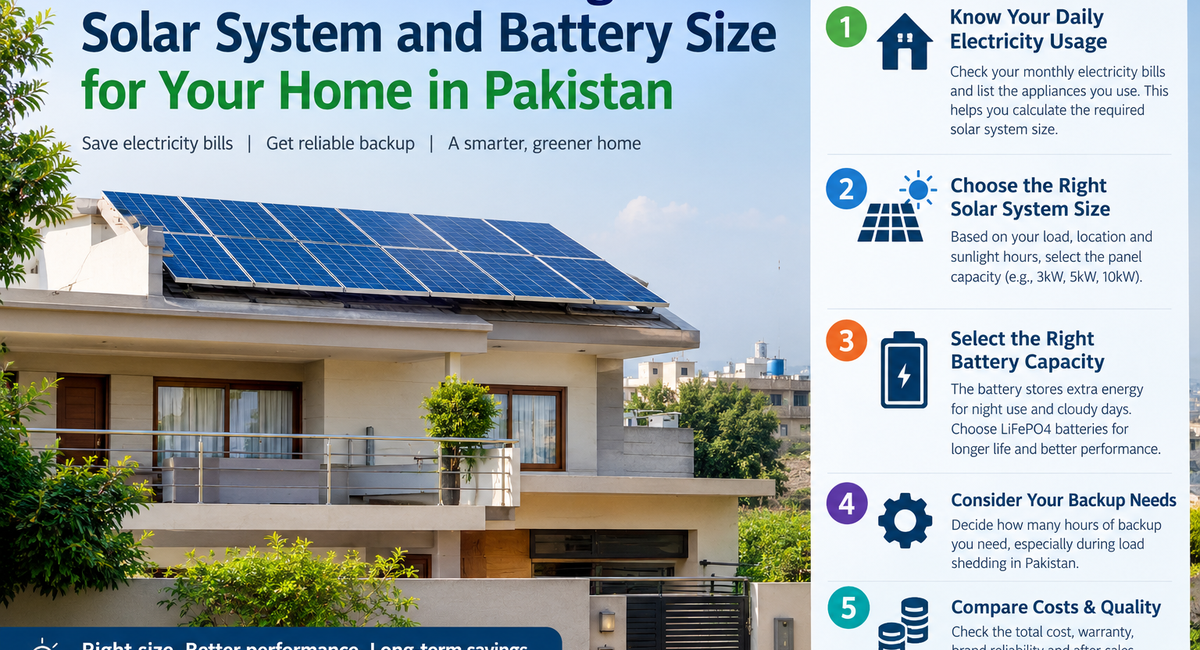
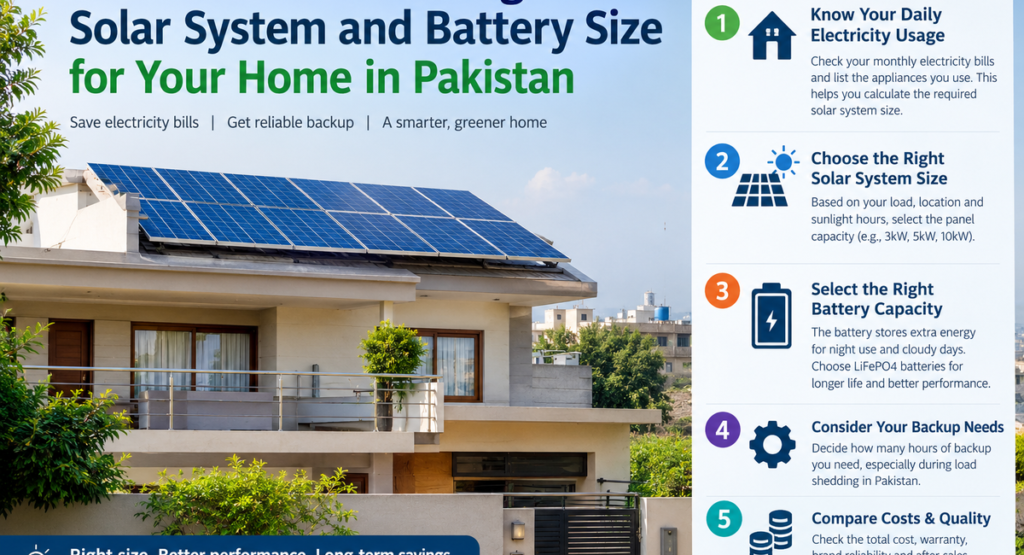
How to Choose the Right Solar System and Battery Size for Your Home in Pakistan Leave a comment
Load shedding, voltage fluctuations, and increasing electricity prices have led thousands of Pakistani households to switch to solar energy. But let me tell you a fact that the majority of vendors don’t want to share with you: panels cannot generate enough energy to give you light after sunset. Your comfort during a blackout depends on two decisions which you will need to take before you spend even one penny: choosing the right solar system size for your home and batteries that can store the amount of energy which will be generated by your solar panels.
If you get those two wrong, then you get something that trips every time you switch the fridge on, or dies after 2 hours into a load-shedding block. This is the guide showing you exactly how installers operate, with detailed steps and simple, clear instructions so you only need to buy once.
First, write down the loads that you would actually run
Before you actually order your first battery or your first panel, I suggest you go grab your laptop and take the time to list the appliances you’d like to have running off the solar. Write beside each appliance the watt consumption and the average number of hoursper dayyou’d use the item.
A general Pakistani house is something as under:
- Four to five ceiling fans-each roughly 75W
- Six to eight light bulbs (LED) each-ten to fifteen W
- One fridge or freezer-one fifty to two hundred fifty W
- The TV, router, two or three phone chargers, etc
- Possibly one inverter A/C (only in summer)
From the watt-hour value of each appliance, add all up-there you have a value of your total daily electricity consumed in units. Then work out the required solar system size for your home, which can help you much better than any salesman out there.
Daily Units Are Much More Important than Marketing Numbers
Once you know your daily units, figuring out solar system size for home is simple arithmetic. If you use 10 units daily, then a 3kW panel system would provide around that many in winters, and more in the long days of summer. A larger house with air conditioning, a fridge, and a water pump would require 5kW and more.
One easy practice to avoid costly miscalculations, measure your daily consumption yourself during a week before purchasing anything. Your electricity bill will give you an idea, but your own assessment of fans, lights, and appliances will tell you what your requirements are once the sun goes down.
Daily Units are much more Important than marketing numbers
Now, once you know your units, then the solar system size for home calculation becomes pretty easy. If you have 10 units of energy consumption per day, then 3 kW panels installed on your rooftop should be enough during winter days when sunlight hits them. A big house that requires cooling, a fridge, and a water pump would require 5 kW panels or more.
One small practice that will save you from unnecessary expenses and bad choices: make sure to count your consumption of energy by yourself for a week before any purchase. The estimate provided in your electricity bills can only give you an estimate; you have to count your appliances yourself.
The Question about batteries people don’t ask
The proper solar system size for a home is irrelevant when the battery lacks the storage capacity to store all that energy. The battery capacity can be estimated in ampere-hours (Ah), but the more practical way is kilowatt-hours (kWh). But there is an important thing to understand: what is shown on the battery label is not the number that you can really use.
A lead-acid battery allows you to use up to 50% of its capacity, or you destroy it quickly. With the lithium iron phosphate (LiFePO4) battery, you can utilize 80-90% of its capacity; it lasts many years longer and can handle much higher temperatures in Pakistan, which is why it became a top choice for Pakistani solar inverters and UPS systems.
To determine the required battery capacity, you just have to ask one simple question: how many hours of backup do you need? Simply multiply the load you require in the evenings by the number of backup hours. The result, when divided by the battery voltage, will lead you to the correct Ah capacity. Add some buffer just for safety, especially for rainy days and guests.
Here is the test of all SJY LiFePO4 Batteries in real conditions, along with detailed information about the whole line of batteries in Urdu, which can help you to decide.
Battery, Voltage, and Inverter Must Be Compatible With Each Other
The 12V battery is suitable for small loads like a few fans and lights. As soon as you install a refrigerator or an air conditioner, it would be wise to go for 24V or 48V systems, as higher voltage leads to lower current and less heat generation in the wires, as well as more efficient operation of inverters.
Your inverter, battery voltage, and charge controller should all match with each other. The use of a 48V battery with a 24V inverter is not going to work at all. Besides, make sure that the wiring between the battery and inverter is rated for the maximum current output of the inverter and not the average, as smaller cables overheating can cause voltage drops, slowly ruining the entire system.
If you’re setting up a lithium battery pack, then having a good BMS (battery management system) is essential. It shields your battery from getting overcharged, deep discharged, short-circuited, overheated, and also makes sure that one defective cell doesn’t affect the whole package.
The Summer Heat and Voltage Fluctuations
In Pakistan, the sizing of the solar system to be used at home needs to factor in some additional buffer, as these local environmental factors tend to hinder the whole operation. Temperatures exceeding 40° centigrade shortens the lifespan of the batteries and reduce the output from the panels. Humidity from the monsoon season impacts the rooftop wiring. Lastly, voltage fluctuations ranging from 160V to 240V put pressure on the charging system.
Some practical tips that help you safeguard your investment:
- Place the batteries in a well-shaded and ventilated area, never in a closed box or room
- Clean the panels regularly, as dust alone reduces the power output per day. Employ the right DC breakers for the connection between panels, batteries, and inverter
- Select components that work efficiently in a high ambient temperature environment and check charge settings after battery replacement
Mistakes That Slowly Drain Money from Your Pockets
There is a popular trend among consumers to rely on estimates rather than measuring the required solar system size for home parameters, which results in frequent tripping of the inverter every evening. Also, some users add an old battery to the new battery and, as a result, lower the performance of the whole battery pack. Last but not least, operating powerful electric motors without increasing the capacity of the system is very common.
The last piece of advice: learn the signals of the inverter before repairing it. It’s quite natural to hear one beep every few seconds from time to time.
Ask for Help Before Purchasing
Solar is a long-term investment, and it will only take you a few minutes to speak with an expert in power systems, which could help you avoid making a costly mistake. The people who have written this guidance have been dealing with batteries, inverters, and solar wiring for more than nine years in Pakistani homes and small companies; therefore, their guidance is field-tested rather than brochure-based.
- E-Mail: maazelectroniks@gmail.com
- Facebook: facebook.com/maazelectroniks
- Online Stores: maazelectronics.pk
If you need any help in determining the battery voltage, choosing an inverter, or selecting a BMS or other components in power systems, then Maaz Electronics can assist you.
