

What Is BMS And Why Every Lithium Battery Pack Needs One Leave a comment
If you are using any of the lithium batteries for your solar, UPS, e-bike, or electric vehicle, you might have come across the term BMS, but what is it exactly, and why is it so necessary for a lithium battery?
Most of us buy a lithium battery, connect it to our inverter or charge controller, and assume it will do its job for ages, and in most cases, it will. However, if some technical error occurs and the battery shuts down unexpectedly or only lasts for a short time than expected, or even worse, physically swells up, the first question that comes to mind is, “What happened?”
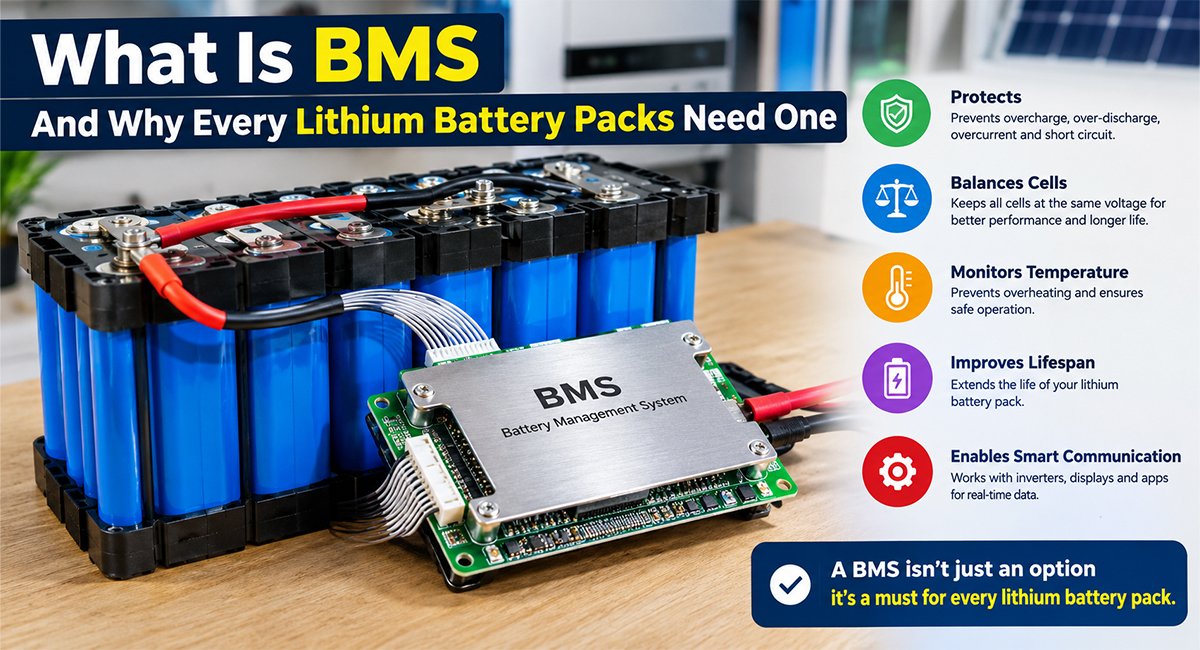
Well, the culprit in most cases is the BMS (Battery Management System), an integrated circuit that is responsible for managing the battery pack. The BMS is an essential part of any lithium battery pack. Without it, you would be using a volatile energy storage device that can be unsafe.
In this article, we will explain exactly what this small printed circuit board is responsible for, why it is an absolute necessity in a lithium battery, and what could happen if you were to use a battery pack without one. We will also discuss the real-world applications of the BMS, for example, in Pakistan, where due to frequent load shedding, voltage fluctuations, and a hot climate, battery packs are put through a lot of stress.
A Customer’s Battery Died after 8-9 Months. Here’s Why
A couple of years ago, a customer in Lahore called me regarding his new lithium battery. He told me he used a 24V lithium battery pack for his solar system, and after 8-9 months, it barely ran his inverter for an hour. I asked him to open the pack and check the cells. The cells were fine, but the management board was cheap and underrated and couldn’t handle the load of his inverter. 3 cells in his pack were permanently damaged due to over-discharge.
The battery itself was not the problem. The management system was.
This is not uncommon. I’ve seen it happen dozens of times before on lithium battery packs. A poor or incompatible Battery Management System caused the premature failure of otherwise healthy cells. The board couldn’t do its job.
Think of it as the guardian angel of your lithium battery pack. An electronic circuit that watches over it during charging, discharging, and times of rest.
A good battery management system will monitor and control vital signs of your battery pack like:
- Voltage of each cell
- Temperature across the pack
- Current going in and out
- State of charge (how full the battery is)
- State of health (how much capacity remains)
Will take action if any of these parameters are out of specification, such as disconnecting the pack or limiting current. Sometimes performs this in a manner that is not noticeable. Balances the current draw from the cells in your pack.
Lithium battery packs are made up of many cells wired together in series to get the needed voltage. These cells need to be balanced, or one cell in the pack will be putting out more current than the rest. The cells in a lithium battery pack are balanced by either bleeding off electrons from the positive electrode or using some sort of power management circuit to reduce the current output of the higher cells until all are equal.
The One Component That Prevents Your Lithium Pack From Catching Fire
If you have used lead-acid batteries, you might know that they are mostly forgiving. You can overcharge them a bit and drain them deeply, and the battery will still work, albeit with a shorter lifespan. However, lithium batteries are not that forgiving
Lithium battery chemistry is powerful and efficient but also quite sensitive. Overcharge it slightly, and it will enter a thermal runaway state, which can cause it to catch fire or explode. Deep discharge it beyond a certain point, and it will be permanently damaged.
That is why we need a management board, which acts as a firewall, protecting the battery from external factors
Below are the primary functions of your battery management system:
1. Overcharge Protection: When the battery is in danger of being overloaded and the voltage exceeds a threshold voltage determined by the management board, the battery is disconnected from the charger to prevent damage to the battery. (It will protect your battery from high voltage, gas generation, and thermal runaway)
2. Over-Discharge Protection: When the battery voltage drops below a preset value, the management board disconnects the battery from the load. (It will protect your battery from deep discharge and cell reversal.)
3. Over-Current Protection: When the battery is at risk of exceeding its current rating, the management system limits or disconnects the current. (It protects the battery from overload and the electronics from excessive current draw.)
4. Short Circuit Protection: When a short circuit happens in the battery, the management system detects it and disconnects the battery from the load. (It will protect the battery from excessive current surges that can damage it.)
5. Temperature Monitoring: Maintains a proper operating temperature of the battery by reducing the current when the temperature is too high. (Pakistan’s summer season is quite harsh; most batteries have a limited operating temperature range.)
A lithium-ion battery pack without proper battery protection can be a ticking time bomb. It can start working properly, but after some time, a minor malfunction can lead to a thermal runaway, a chain reaction that can damage all the cells and cause the battery to catch fire. Thus, a battery management system ensures that your lithium-ion battery pack is safe.
What Happens When A Cheap Management Board Fails You?
You might think that your battery pack is fine, and you have no idea what management system it has; it comes with a built-in management system.
Lithium batteries have a built-in battery management system. Most of the time, the management system is decent and can do its job adequately. However, some budget lithium battery manufacturers utilize low-end management boards, resulting in lower overall performance.
An inadequate battery management system can manifest in several ways, as discussed below:
1. Uneven Backup Time: You may notice that your battery pack is not holding the same number of hours per charge as you are used to. The voltage is nominal, but the battery pack has less energy than expected due to the BMS (Battery Management System) not balancing the cells properly, essentially causing them to enter a low-voltage state sooner than optimal.
2. Sudden Shutdown: Your inverter shuts down suddenly and unexpectedly in the middle of the day. It happens due to cell imbalance; one of the cells went into a low-voltage condition, shutting down the inverter. A healthy management system would have kept the cells balanced, preventing the inverter from shutting down.
3. Battery Won’t Charge: The battery pack cannot charge; the charger keeps failing. It happens because of the malfunctioning battery management system. Sometimes, the battery management system needs to be reset manually and is triggered by other low-level battery faults.
4. Swollen or Hot Battery: If you feel that your battery pack is getting warm or swollen, it is a sign that the management system has failed and allowed the battery to overcharge and discharge, damaging the cells. It is a severe issue, and you must not ignore it.
5. Inconsistent Communication: The battery management system uses smart communication software, such as CAN bus or RS485 cable, to communicate with the inverter and the charger. You may notice error codes coming up on your display inconsistently; it might indicate improper communication between the charger and the battery. Sometimes, the communication system gets glitched and causes errors.
It is not a rare occurrence. Battery technicians in Pakistan often encounter batteries with shortened run-times that had nothing to do with defective cells, but were caused by undersized, incorrectly configured, or otherwise inadequate management systems.
How A battery management system Adds Years to Your Battery’s Life
A lithium battery pack is a big investment. Whether you use it for storage, backup power, or an e-bike, you want it to keep working for as long as possible. And the management board is directly responsible for the operational durability of your battery.
That’s why you should think of it as a preventive maintenance tool. Not a repair kit. The board allows you to keep your favorite pack in excellent condition for much longer by constantly adjusting the charge/discharge conditions and keeping all cells within acceptable limits.
Here is how a BMS (battery management system) increases battery life:
- Cell Balancing: In most cases, when batteries are connected in series, their characteristics differ slightly. The management board ensures that individual voltages remain within the prescribed limits during charging and discharging. A passive or active balancing circuit compensates for voltage imbalances between cells.
- Temperature Management: One of the leading causes of lifespan reduction in lithium batteries is improper temperature control. By constantly monitoring the temperature of the battery, the management board can limit the current and stop the battery from working if the temperature is too high. Temperature is especially important in Pakistan, where temperatures often rise above 40 degrees Celsius.
- State of Charge Accuracy: A reliable BMS provides you with accurate information about the degree of battery charge. This allows you to avoid situations where you discharge the battery to a lower voltage than specified by the manufacturer. This, of course, will prolong the life of your battery.
- Fault Logging: Most of the modern battery management systems have a built-in function for storing information about the last failures. Having analyzed the cause of the failure, you will be able to solve similar problems in the future without spending time and money on expensive technical support.
Protection Against Reverse Polarity: Some of the BMS units also have built-in protection against polarity connection errors. This feature can save you a lot of trouble and even protect the battery itself from damage if you accidentally connect the battery incorrectly.
So, you see, a worthy management board makes all the difference between 5-7 years and 18 months of battery life. Of course, the cost of the board is much lower than the cost of replacing the entire battery pack.
Watch A Management System Work In Real Time On A LiFePO4 Cell
Understanding the principles of the BMS operation is great, but it is much more fun to watch a real-time example. If you are using a lithium-phosphate battery, studying the practical application of the BMS will help you better understand how it extends the life of your battery in real time. Due to the unique characteristics of the LiFePO4 cells, the voltage practically does not change during discharge, which is why you need a management board that monitors the battery’s state of charge:
Here is a great video that shows how the BMS works on a lithium-phosphate Battery:
Embed this YouTube link
The video shows real-life setup and configuration, and exactly how the board is protecting the battery pack during both charging and discharging. It is an excellent reference for anyone trying to configure their own setup or troubleshoot an existing one.
Picking a Wrong BMS Can Ruin Your Whole Battery Pack
There are a few essential factors to consider when picking a management system for your battery pack. We cannot stress enough how important it is to pick the right management system for your battery chemistry, voltage configuration, and intended use.
- Know Your Battery Chemistry
- Different lithium battery chemistries have different voltage characteristics. For example, a BMS designed for lithium-ion batteries will not work for lithium iron phosphate cells. One has a nominal voltage of 3.6V – 3.7V per cell, while the other has 3.2V per cell.
- Determine Your Series Configuration
- The number of cells connected in series will determine your nominal voltage. 4S configuration has a nominal voltage of 12V, 8S has 24V, 16S has 48V, and so forth. The management board you pick should be able to handle your specific series configuration.
- Check The Current Rating
- Make sure the system you pick can handle your maximum continuous current and higher. If your inverter only runs on 60A, picking a management system that can only handle 100A continuous current defeats the whole purpose.
- Look For Active vs Passive Balancing
- Passive balancing is simple, inexpensive, and ineffective. On the other hand, active balancing can handle larger packs and is much more efficient. We recommend picking a management system that has active balancing, especially if you have a large pack.
- Consider Communication Features
- Some of the latest smart inverters and solar charge controllers utilize CAN bus communication. If you have such a setup, make sure the management board you pick can communicate with the rest of your system.
- Evaluate Build Quality
- Always invest in a reliable management system. Cheap and unknown brands might save you a couple of bucks in the short term, but they will ultimately cost you much more in the long run.
Why Solar Battery Packs In Pakistan Need This Kind Of Protection
The need for a Battery management system becomes apparent when looking at the different applications lithium battery packs have in Pakistan. Let’s analyze some of the most common applications and see why they need the kind of protection we showed you above.
Solar Storage Systems
With the growing awareness of the need to reduce electricity consumption, many Pakistanis are choosing to generate their electricity and store it in battery packs for later use. A solar battery pack is subjected to the most stress since it is charged and discharged on a daily basis.
A quality management system makes sure that the pack is charged within safe limits by the solar charge controller and is not discharged too deeply when the main inverter is drawing power from it. You can’t just hook up any battery pack to your solar system, especially if you plan on using it in conjunction with a charge controller.
UPS Battery Packs
Many businesses and residents in Pakistan utilize UPS battery packs to provide emergency power in the case of a blackout. However, most of these systems are designed to work with lead-acid batteries. A lithium battery pack with a good management system will emulate the characteristics of a lead-acid battery, while being much safer and longer-lasting.
In other words, the management system serves as an intermediary between the UPS charger and the lithium battery pack. Most of the problems we see in lithium UPS batteries are a result of trying to use a lithium pack with a standard UPS charger. If the management system senses unsafe charging parameters from the UPS charger, it will disconnect the battery pack, causing the UPS to shut down.
E-Bikes And Electric Cars:
E-bikes are becoming more and more common in Pakistan, and for good reason. They are a cheap and efficient means of transportation. The battery packs on e-bikes undergo the most stress since they have to provide power to make the bike move, and then get charged again while the bike is being braked.
The management system on an e-bike battery pack is usually small, but it has to be able to handle high currents. A faulty management system on an e-bike battery can be downright dangerous since it can cause the bike to lose power suddenly while you are riding it. This is why most of the e-bike battery manufacturers we work with stress the importance of a good management system as much as the cells themselves.
The Communication Problem Between Inverters And Management Units
We often overlook compatibility issues when installing lithium batteries. If your inverter and board are unable to communicate properly, you could experience unexplained shutdowns, slow charging, and even battery damage.
Modern inverters usually allow you to set lithium battery profiles in their firmware. However, the profiles are built-in, and they assume that the battery pack has a management system that is compatible with communication protocols that the inverter expects
For example, if your board communicates via CAN bus while the inverter expects RS485, the inverter will charge the battery based on voltage and not state of charge.
When installing lithium batteries, make sure that your battery pack is compatible with your current inverter or charge controller.
What Your Management Board Does While You Sleep
We have discussed the performance benefits, but the primary role of the BMS is to keep your battery safe.
Lithium batteries pack a lot of energy in a small package, and for that reason, any sort of malfunction during charging or discharging can result in severe thermal runaway, fire, explosion, and damage to the surrounding equipment
A proper management board will protect your battery from
- Thermal runaway from overcharging
- Fire from short circuits
- Explosion from internal pressure buildup
- Damage to equipment from voltage spikes
If you are in Pakistan, a country with frequent load shedding and unstable voltage, you understand why a management board is a necessity and not an option
If you have a lithium battery without a management board or with a low-quality management system, it is only a matter of time before you have an incident.
A Checklist Before You Buy A Management System
Depending on your battery pack, you might need a management board with different capabilities. Here is a quick guide:
- 4S to 8S Packs (12V to 24V): These are usually smaller battery packs that are used in smaller solar systems, UPS, and e-bikes. Look for something in the range of 50A-100A with passive or active balancing and temperature monitoring.
- 8S to 16S Packs (24V to 48V): This is the most common battery pack size for residential solar systems and larger UPS. You will need something in the range of 100A-200A with active balancing and communication features.
- 16S and Above (48V and Higher): These packs are used in large-scale solar systems and electric vehicles. The management system should be able to handle higher voltages and currents with advanced balancing and protection circuitry.
Brands like DALY and Jikong offer systems that cover a wide range of configurations. When selecting a management board, match the series count, current rating, and chemistry to your specific battery pack.
Need Help Selecting The Right Management System?
If you have any questions regarding choosing the BMS for your lithium battery pack, or you need help selecting batteries, inverters, or charge controllers, feel free to contact us at
We are available 24/7 via WhatsApp to answer your questions.
Final Verdict: A Battery Management System (BMS) plays the role of a guardian for any lithium battery pack. It protects your investment and prolongs the life of your battery by several years. In Pakistan, with its frequent load shedding, a lot of voltage fluctuations, and extreme heat, battery packs are under a lot of stress. Any kind of malfunction during charging or discharging can result in severe thermal runaway and destruction of the whole battery pack. A good management system is mandatory for all lithium battery packs. It is vital that you choose the right system and that you do not compromise on quality. When choosing a BMS, it is essential that you do not compromise on quality. A good management board will protect your investment and extend the lifetime of your battery by several years.
