

What Does 4S 8S 16S 24S BMS Configuration Mean Leave a comment
Have you ever come across such numbers listed in product details while looking for a battery pack online? 4S, 8S, 16S, 24S have you? These numbers might confuse you if you are purchasing a battery pack or replacing the lithium pack for the very first time, but they actually tell you a lot about your battery pack and BMS.
This is one of the most common mistakes made by individuals when buying a BMS, so make sure you understand what it means before spending any rupees at all.
“S” Stands For “Series Cells”
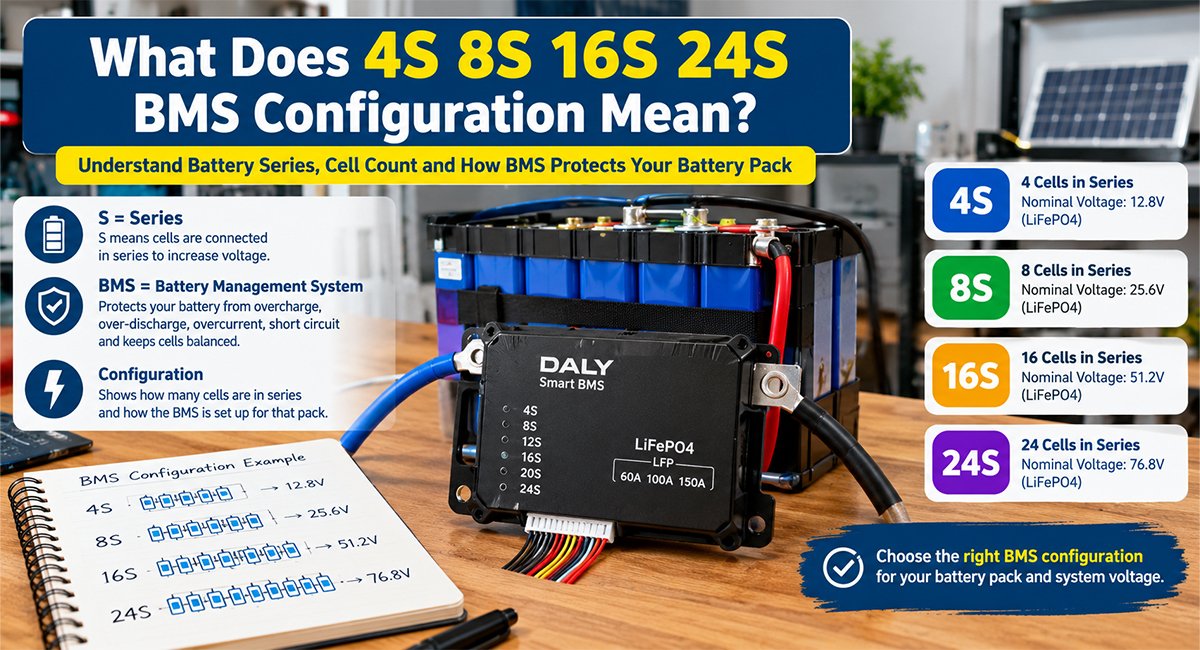
Whenever you come across a number followed by ‘S’, the number shows the number of lithium cells connected in a row (positive to negative), end-to-end to form a string. Connecting cells in such a way increases the voltage of each cell. A typical LiFePO4 cell operates at about 3.2V. Therefore, a 4-cell arrangement (4S) will give a battery pack of 12.8V, 8 cells (8S) will provide about 25.6V, 16 cells (16S) will give about 51.2 V, and 24 cells (24S) will give about 76.8V.
That is the reason why a BMS designed for a particular pack cannot be used in another configuration pack. A BMS that can monitor 4 cells will never be able to control a pack of 16 or 24 cells.
The Importance Of Matching BMS Capacity With The Number Of Cells
The most important task of a Battery Management System is to monitor each cell separately and not the battery as a whole. BMS monitors the voltage of each cell separately, measures temperature, and intervenes whenever there are any deviations from normal conditions. If the BMS capacity is 8S, but you have 16 cells connected in series in your pack, the rest of them will not be monitored at all, and thus there is no point in using the BMS at all.
This is the reason why product specifications tend to be clear on configurations. It is common to find one BMS mentioned to support a certain range, such as from 4S to 8S, and from 8S to 16S. The range indicates the capability of the BMS to be configured for any number of cells between the mentioned numbers.
Relationship Between Voltage Class And Series Count
After calculating the series count, the nominal voltage of your battery can be easily predicted. The 4S series battery falls under the 12V class of batteries, which is typically used for smaller backup batteries. The 8S battery falls under the 24V class of batteries, which is higher in capacity than the 12V battery class. The 16S battery falls under the 48V class of batteries, which is the most common battery voltage used for large solar-inverter batteries in Pakistan. A further increase in series count to 24S will result in higher voltages used in more powerful batteries and EV batteries.
This information is useful to ensure that a product listing is accurate before purchasing it. In case a vendor offers a 48V battery, then a 16S setup and BMS for that particular number of cells is expected, not an 8S one.
What The BMS Is Actually Doing Behind The Scenes
Once matched correctly, a BMS handles a handful of jobs continuously, not just occasionally. It watches for overcharge, so no single cell gets pushed past its safe upper voltage. It watches for over-discharge, cutting off the load before cells drop dangerously low. It monitors current, disconnecting the circuit if something draws more than the pack can safely handle. It protects against short circuits almost instantly. And it tracks temperature, stopping charging or discharging if things get too hot.
On top of these protections, many BMS units also handle cell balancing, redistributing charge between cells so that no single weak cell in the string drags down the performance of the whole pack. This becomes more important as series count increases, because a 16S or 24S pack has far more opportunity for small differences between cells to add up.
Watching The Wiring In Practice Helps It Click
Reading through series counts and voltage classes is useful, but actually seeing a BMS wired into a real LiFePO4 pack makes the whole concept click much faster. This walkthrough shows how a DALY intelligent BMS & JK Jikong BMS gets connected and configured on a lithium iron phosphate battery, and it’s worth watching if you want to see the balance leads, main power connections, and setup in action:
Reading A Product Listing Correctly Before You Buy
When you’re comparing BMS listings, a few details matter more than the price tag. Check the exact series range supported, since a listing might say 8S to 16S rather than one fixed number, meaning it can be configured within that window but still needs setting up correctly. Compare the steady-state current draw with that of your inverter or the actual load, instead of using the average current draw. Also, verify the chemistry, as lithium iron phosphate and normal lithium-ion batteries have a different cut-off voltage, which means that the BMS designed for one cannot work effectively for the other.
It also makes sense to find out whether the balancing process is passive or active, as the active method works well with bigger battery packs with many series batteries.
Why This Is Important In Pakistani Conditions
If your battery pack is running a solar system or UPS through daily load shedding, your BMS is working harder than a similar setup in a country with stable grid power. Frequent charge-discharge cycling puts more strain on cell balancing. Voltage fluctuations from the grid or from lower-quality charging equipment increase the chance of a charger pushing more voltage than a cell should see, which is exactly the kind of event overcharge protection exists to catch. Summer heat adds another layer of stress, since higher ambient temperatures make a BMS’s temperature-cutoff function more relevant, not less.
Getting the series count and BMS specification right the first time matters more here than in milder climates, because a mismatched or undersized BMS gets tested by these conditions far sooner than it would elsewhere.
How To Get Help For Matching Series Count With Your Pack
If you have no idea what pack is yours, be it 4S, 8S, 16S, or 24S, or which BMS actually fits your battery, then you should definitely do something about that because it can result in your batteries becoming vulnerable. The company of Maaz Electronics has been directly working in the field of electronics and power systems in Pakistan for more than 9 years, and it has gained extensive experience with exactly those problems that occur with the choice of BMS and battery packs at households and companies.
Series count isn’t just a label on a product page; it’s the number that decides whether your BMS can actually do its job. Whether you’re assembling a pack yourself or replacing a BMS on an existing battery, checking the series count against the BMS specification first will save you from a mismatch that no amount of good cells can fix on their own. For business inquiries, reach out at 𝐦𝐚𝐚𝐳𝐞𝐥𝐞𝐜𝐭𝐫𝐨𝐧𝐢𝐤𝐬@𝐠𝐦𝐚𝐢𝐥.𝐜𝐨𝐦.
