

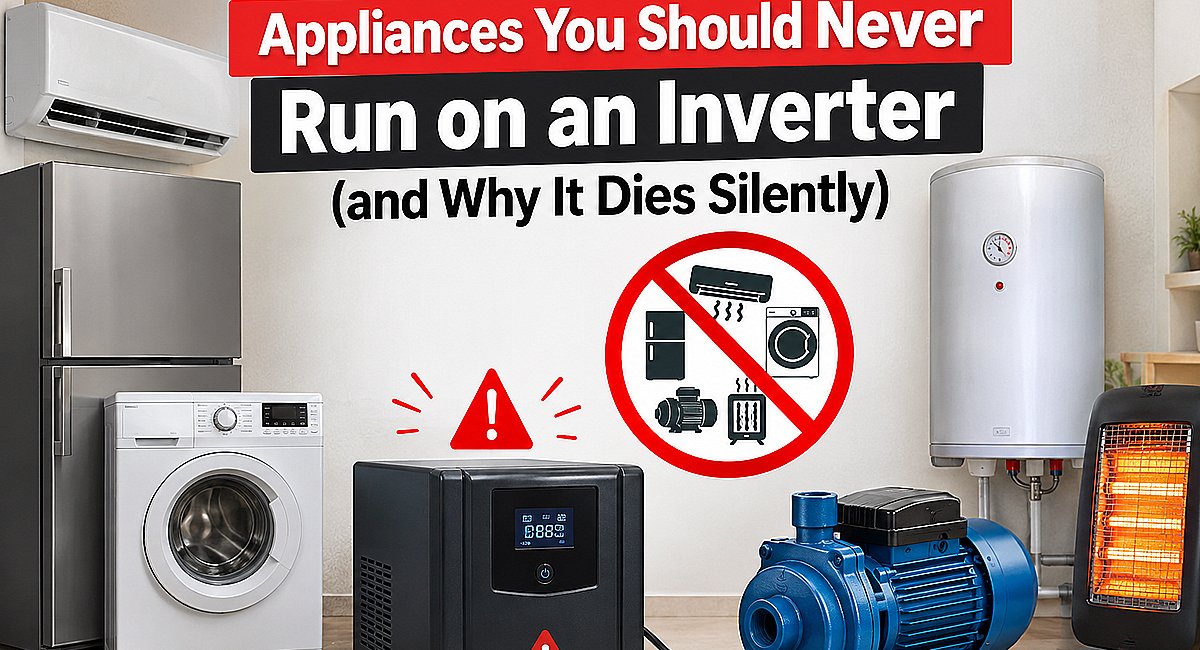
Appliances You Should Never Run on an Inverter (and Why It Dies Silently) Leave a comment
It is 8 PM, load shedding starts, and your inverter takes over. Everything feels normal. Then a few months later, your backup time drops, the inverter beeps more than it used to, and one day it just stops responding. No smoke, no warning lights, no drama. It dies silently.
This is one of the most common problems in Pakistani homes, and the cause is usually not a faulty inverter. It is what you plug into it. Knowing the Appliances You Should Never Run on an Inverter can save you from replacing your battery and inverter years before their time.
Why your inverter fails without making a fuss
An inverter does not complain loudly when you stress it. It quietly handles loads it was never designed for, and the damage builds up inside.
This is how it works. As long as your battery is fully charged, the inverter produces voltage that is consistent. But when the battery is discharged, the output voltage is reduced. This reduction is detected by the motors and compressors, which have to try extra hard to start. With each start, current surges through, heating up the inverter parts and discharging the battery even further.
Deep discharge and heat are the two biggest reasons inverter batteries lose capacity early. Add summer temperatures that regularly cross 40°C in Pakistan, and your system is aging much faster than the label on the box suggests.
The air conditioner: the fastest battery killer
There is no doubt that there is an appliance that can damage inverters in Pakistan much more than others, and this appliance is the air conditioner.
When a 1.5-ton split air conditioner is on, it consumes power of 1500W, which is more than enough to test most household inverters. The critical thing about this appliance is the moment of starting. During this process, it requires 5000W – 9000W for several seconds. It can stand it for some time, but after several compressors start with an undercharged battery, your inverter will not cope with it.
The result is silent: swollen capacitors, stressed MOSFETs, and a battery that ages years in months. If someone asks you to list the Appliances You Should Never Run on an Inverter, the AC belongs at the top.
Fridges and freezers are not as innocent as they look
Most people consider that since the size of the refrigerator is small, it will be safe. No. Fridges and freezers are also equipped with compressors that run intermittently throughout the night. With each switching of these compressors, there is a little surge in current.
The situation is very dangerous when you use the refrigerator with the help of a very old battery. With the sagging voltage and inverter overheating, the result is reduced backup or tripped inverters during a power cut.
If you have no option but to use your fridge during backup, then use it only within the first hour of power failure.
Water pumps and motors pull more than you think
A water pump looks simple, but motors draw two to three times their running current at startup. A small 0.5 HP pump can easily demand over 1000W at the moment it starts, and it does this every time the water tank empties.
If you want to see what a battery and inverter pair can actually handle, watch our 24V 100A backup testing video where we put a lithium setup through real charge and discharge cycles on our YouTube channel. You will quickly see why motors are so hard on inverter systems.
Heating appliances are pure load with no mercy
Electric irons, water kettles, immersion rods, and geysers convert electricity directly into heat. That means they draw enormous current continuously, with no startup surge and no rest.
An iron alone can pull 1000W to 1500W for as long as it is on. On a typical 1000W to 2000W home inverter, a single iron can push the system into overload within minutes. Running these regularly is one of the quickest ways to kill both the inverter and the battery, which is why they appear on every honest list of Appliances You Should Never Run on an Inverter.
Microwaves and washing machines
The microwave uses a lot of energy only when it is working, yet the energy is a lot, and it is difficult for ordinary inverters designed to accommodate fans and lights to withstand it. The washing machine consists of a motor, a heater, and a pump and is even more difficult to use.
What your inverter can actually carry
A properly sized home inverter handles ceiling fans, LED lights, TVs, WiFi routers, phone chargers, and laptops without stress. These loads are steady, gentle, and predictable. If your backup time is falling even with these, the problem is usually battery health, not the load. Remember, one beep every four seconds is often normal. Constant beeping after adding an appliance is your inverter telling you it is overloaded.
Give your inverter a longer, quieter life
A few habits make a real difference:
- Keep battery discharge above 50% whenever you can
- Place the battery and inverter in a ventilated, shaded spot
- Use the correct charger and charging settings for your battery type
Upgrade to LiFePO4 lithium batteries if your inverter supports them, since they tolerate deep discharge far better than lead-acid
If you are unsure which appliances your system can handle, get your setup checked before something dies silently in the background.
Talk to us before your next battery or inverter
Have questions about your backup setup, or planning to upgrade? You can reach us on WhatsApp at 0327 6334277 or 0313 7910121, Monday to Saturday from 8 AM to 8 PM, or message us anytime on WhatsApp. Our team reviews real installations across Pakistan and can help you match the right battery and inverter to your actual load, not guesswork.
A little about who is behind this advice
This guidance comes from Maaz Electronics, where Maaz Gilani has spent over nine years working hands-on in Pakistan’s electronics and power-systems market, inspecting batteries, testing chargers, and diagnosing inverters in homes and small businesses. If you are a business looking to stock batteries, inverters, BMS units, or solar equipment, you can reach us directly for business inquiries at maazelectroniks@gmail.com
