


Wall-Mount or Rack-Mount LiFePO4 Battery That Fits Your Space Leave a comment
When designing solar or backup power stations, people pay the most attention to the battery choice. However, the installation method will be of great importance after the model selection. Wall-mount or rack-mount LiFePO4 batteries have been a topic of debate between potential buyers because of their different features. Most of them think that this decision depends on preference only, but that is not true.
This article will describe the differences in detail so you can make the decision regarding your room, equipment, and preferences.
What Does Wall Mount Mean?
The wall-mount LiFePO4 battery hangs directly from the wall like a flat-screen TV or wall cabinet. The mounting of such a battery implies using a mounting bracket. The battery itself attaches to the wall surface.
This type of setup works very effectively when there is a lack of floor space available. This is a typical problem for the Pakistani people, where utility rooms or storage rooms, or even rooftop setups tend to have a smaller area available. Therefore, when you need to fit a battery beside the inverter, wall mounting becomes the right choice to ensure that the floor remains free for the installation of other equipment and wires.
Most LiFePO4 batteries that are wall-mounted are typically single-unit batteries only. Therefore, when you are looking to choose between wall-mount or rack-mount LiFePO4 battery options, remember that the wall mount works best in cases where you need just one unit.
What is Rack Mount, And How Is It Unique?
A rack-mount battery is designed to be installed in a server-like rack or cabinet in tiers, one on top of the other. Such an arrangement is typical for the installation of several battery units that, combined together, will create one big power storage station.
In case you need a greater backup system at present, or plan further expansion in the future, rack mounting will provide you with the ability to expand gradually. Rather than buy one big battery, you’ll be able to install a new unit in the existing rack in case the rack and inverter are designed for such use.
Rack mounting does require some initial consideration on your side. Namely, you should have enough vertical space, a good-quality rack or cabinet, and proper ventilation for the stacked units, as the summer in Pakistan can raise ambient temperature in a closed room far above comfortable limits even for a lithium-ion battery.
Space Is The First Thing You Should Measure
When making your decision between wall mount or rack mount, physically measure the space where your battery pack is supposed to be installed. Be aware of the amount of wall space required for brackets and the amount of floor space that can accommodate a rack.
Many people ignore this part of the process and end up disappointed once they receive their item. Wall mount requires a sturdy wall capable of carrying the load, while rack mount requires a level surface that has enough space for accessing the connections.
When dealing with a small utility room or a corner of your roof, you would better consider wall mounting your unit. If you have extra space inside your equipment room, rack mounting might be a better option.
Weight And Installation You Must Not Ignore
LiFePO4 batteries are lighter than traditional lead-acid batteries having the same capacities, but still, there is a considerable weight of these batteries, particularly, the large-capacity ones. Wall-mount systems depend on the wall, and mounting brackets must be designed to carry this weight; thus, the wall and mounting material should be solid rather than merely decorative drywall or weak brick walls.
Rack-mounted systems have an advantage in terms of weight distribution because they use the rack structure for this purpose, and in general, a well-made rack can withstand the weight of numerous such batteries, arranged one over another.
Ventilation and Heat: Two Important Factors You Might Overlook
The summer heat in Pakistan really challenges any battery system, but when it comes to deciding whether to use wall mount or rack mount for LiFePO4 battery installation, ventilation takes on added significance. When a single battery is mounted on the wall in an open and spacious place, it receives adequate air circulation around it. However, the rack-based system might become problematic if not adequately ventilated because it might accumulate heat between the batteries installed on top of each other in a closed and inadequately ventilated storage area.
No matter what kind of installation you choose, avoid storing the battery system in a tightly sealed cupboard or any other confined space without proper air circulation. This will certainly impact the overall performance of the battery.
Embed the YouTube link here
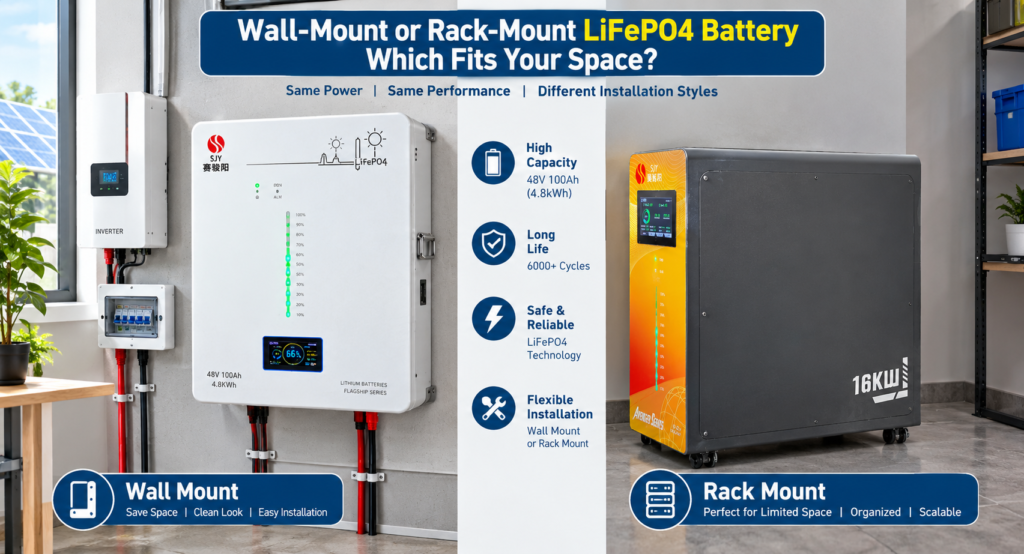
The Mount Option Based On Your Real Needs For The Battery System
Consider your requirements for power backup honestly, and determine whether you have a fixed moderate load without much possibility of future growth. In such a case, a wall-mounted LiFePO4 battery will suit you better since it requires less usable space to accommodate.
If you are running a business or a larger household with growing power demands that are likely to grow in the future, a rack-mounted system will work out perfectly for your purposes, as you can begin with one battery and increase its number whenever required in the future, and this avoids the hassle of changing the whole system.
At Maaz Electronics, both wall-mounted and rack-mounted LiFePO4 batteries are available in the list of batteries, and hence when customers try to compare wall-mounted or rack-mounted LiFePO4 batteries, they get the real listings of the products.
A Few Words On Voltage Fluctuations And Load Shedding
Regardless of whichever mount option you decide to go for, one thing to keep in mind is that voltage fluctuations and load shedding are quite common in most of the country, which makes installation, charger selection, and mount stability as important as the specification of the battery itself. A poor wall mount bracket or an overcrowded rack will not do its job regardless of how great the cells are within the battery.
In case you have any queries related to which mount style is best suited to your room dimensions, the inverter system, or future additions you are planning, feel free to contact me through my email address: maazelectroniks@gmail.com. The staff will advise you regarding your own particular situation.
Maaz Electronics has had nine years’ worth of experience in the Pakistani market of electronics and power systems, and this experience is reflected in how our mount styles are presented, focusing on practicality rather than on a one-size-fits-all approach. So, whichever option you end up choosing, wall mount or rack mount, make sure to take your time and do the math right.
