

MPPT Or PWM Solar Charge Controller: Which Is Better For Pakistan Weather Leave a comment
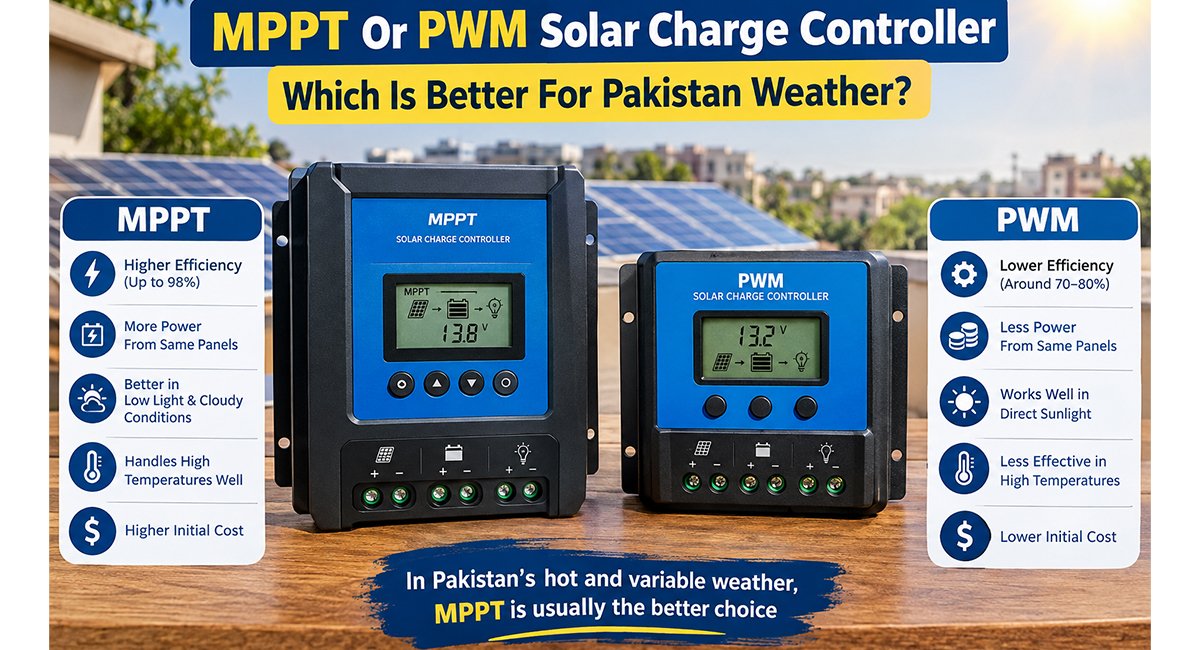
You might have wondered about MPPT vs PWM Solar Charge Controller when shopping for a Solar System in Pakistan. Both controllers are available in almost all solar kits that we saw in Pakistan. And they both promise to perform the exact same task. However, given the fact that our country has high temperature variations, dusty rooftops, and sudden voltage swings, there’s a reason why most people want to know about MPPT vs PWM before buying a solar charger!
So let’s find out: what exactly can these two controllers do? How do their performances differ from each other under real-world conditions in Pakistan? And based on that, which solar charge controller will be best suited for your project depending upon your budget, Panel Size & Battery Type? Read on!
What a Charge Controller Is Actually Doing in Your System
Now, before jumping into MPPT vs PWM Solar Charge Controller, let’s first figure out why we require a Charge controller. Whenever sunlight hits our Solar Panels, they produce electricity. But this electricity can’t be used directly by the batteries, as this will damage your cells with Overcharging, Wasting of energy, etc.
So, to protect our Battery Cells & keep proper flow of Currents/Voltages, A controller is required to be connected between the panel and the battery. Both Controllers (PWM & MPPT) do the same thing but just in a different way. Which makes a Huge Difference in Usable Power from your panels. So Let’s Deep Dive!
The Difference Between PWM and MPPT Technology
In the operation of a PWM controller, there is a direct electrical circuit that links your solar panel and your battery. This controller uses the concept of pulsing in order to regulate the rate at which the battery charges. Since the direct circuit exists in such a setup, it means that the voltage level of the solar panel drops to the voltage level of the battery, and hence any extra voltage that could be present is lost.
The MPPT controller operates in a different manner in the sense that it always seeks the maximum power point of the solar panel and therefore it converts the extra voltage into extra current.
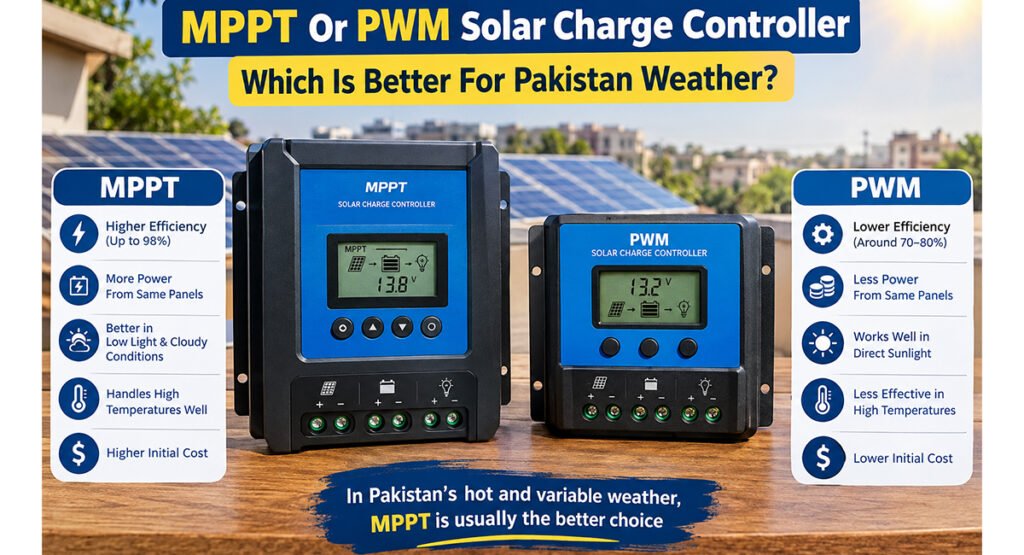
This is the essence of the MPPT vs PWM solar charge controller debate: PWM is simple and cheap, whereas MPPT is intelligent and effective in maximizing the utilization of sunlight.
How the Climate of Pakistan Affected the Choice
The climate in Pakistan is not conducive to solar systems. In cities such as Multan, Bahawalpur, and Karachi, the temperatures in summer reach above 40°C, while rooftop panels may even become warmer than the ambient temperature. Higher temperatures cause the panels to have a reduced voltage output, which affects the performance of different controllers differently.
PWM controllers suffer from decreasing efficiency when there is a higher difference between the voltages of the panel and the batteries, which is typical in the summer heat in Pakistan. MPPT controllers cope with this situation much better due to their dynamic nature.
Dust is another parameter that is easily overlooked when talking about MPPT vs PWM solar charge controller comparisons. Accumulated dust on panels leads to low absorption of sunlight and low efficiency of work. Thus, when your panels produce low energy due to dust anyway, getting as many watts as possible via an MPPT controller will be much more important for you, as you will not be wasting the voltage you have got.
The voltage fluctuation in grid-tied hybrid systems and low stability of charging are other usual problems faced by Pakistani families. In this case, MPPT controllers can deal with such issues better, thanks to their own tracking and regulation.
To see how the MPPT controller behaves while operating, here is a practical guide to Suoer 30A MPPT Charge Controller operation
When a PWM Controller is Still Useful
While there is an efficiency difference, that does not mean that the PWM controller is obsolete. In small-scale setups where the voltage of your panels matches the voltage of your batteries, the PWM controller will work nearly as effectively as the MPPT with much less effort needed to set up and maintain.
In simple setups where your panels only need to charge one 12V battery, for example in the case of a small rooftop panel powering lights or fans during load shedding, you won’t have to go beyond the PWM controller. Pakistanis with simple backup power systems use PWM controllers for the same reason.
When MPPT Wins In Practical Summer Conditions
Large-sized panels make a difference. If you have a large panel set up for charging a 24V or 48V battery bank, or you have a system with lithium batteries, such as LiFePO4, then the voltage difference between panels and battery becomes much higher. This is precisely the case when the MPPT vs PWM solar charge controller question is answered in favor of MPPT.
Moreover, the MPPT controller works better in a hybrid solar inverter system since the compatibility of batteries and charging becomes more critical, as the battery will serve dual purposes: store energy generated from solar panels and back up power during outages. Considering frequent voltage fluctuations and prolonged charging season in Pakistan, MPPT justifies itself over time with better daily results despite being more expensive than PWM.
Selecting the Right Controller According to Battery Type
Regardless of which controller you decide to buy, make sure it fits your type of battery. Different types of batteries like lead acid, AGM, gel, and lithium all require different voltages in the charging process and wrong controller settings will damage your battery even if you bought the MPPT or PWM. In any case, it is always advised to check the recommended charging voltage before purchasing.
At Maaz Electronics, this is perhaps one of the most common concerns our customers raise regarding which controller is appropriate according to their solar panel size, battery, and local climate conditions. Providing the customer with this information and explaining the differences is perhaps one of the reasons why selecting the controller has become easy for Pakistanis.
If you have any queries regarding your configuration, please don’t hesitate to contact us. Maaz Electronics can be reached at maazelectronics@gmail.com to advise on selecting MPPT and PWM options for your system.
Choosing What is Best for Your Setup
There is no one winner in the MPPT vs PWM solar charge controller contest. While small and economical systems with comparable voltages may work just fine on PWM systems, larger systems, those using lithium batteries, as well as systems in Pakistani summers where heat and dust will be encountered on the roof, will benefit more from MPPT controllers.
