

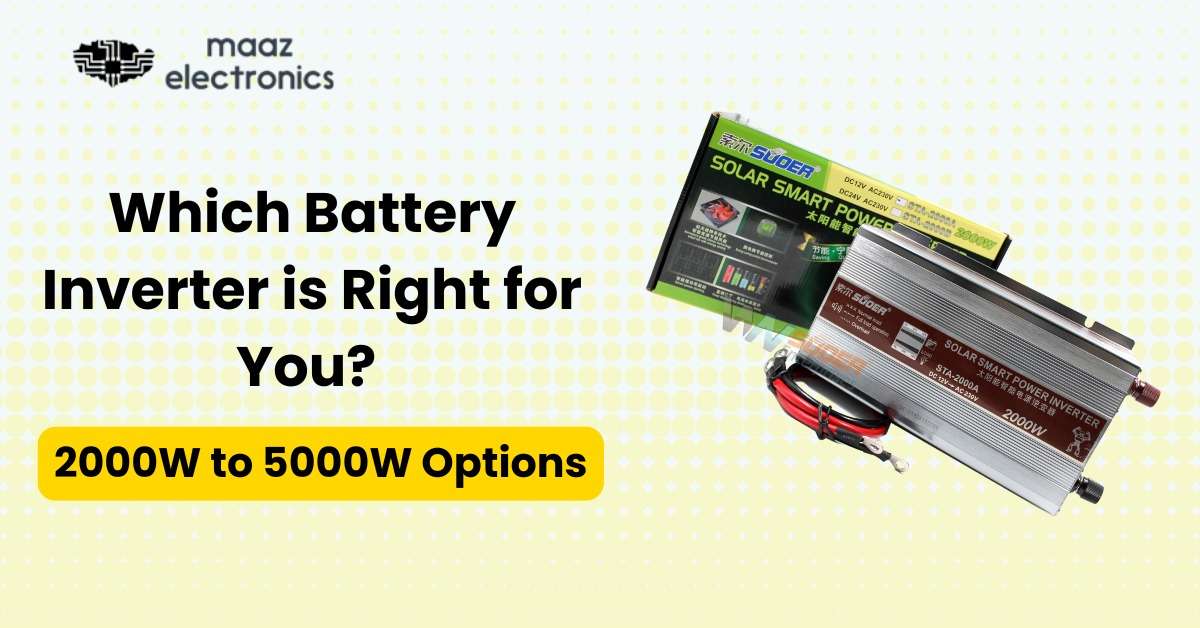
Which Battery Inverter is Right for You? Real Advice for 2000W–5000W Systems (2026) Leave a comment
Why Picking the Right Inverter Really Matters — From My Workshop

I’ll be honest with you: choosing an inverter once felt like picking a random number off a spec sheet. I remember helping install a backup system for an office, and the homeowner insisted a 2000W inverter was enough he only needed lights and a fridge during outages. But once installed, the system would shut itself off whenever the water pump kicked in, even though the total measured load was well under 2000W.
Turns out, surge loads and real‑world startup currents were the culprit something no spec sheet had clearly explained to him. That experience taught me:
The wattage number on the box isn’t the whole story.
You must look at how you use power, not just how much you think you use.
This is especially true when you’re choosing between 2000W, 3000W or 5000W inverters for home or business power backup.
Similar shutdown behavior is also common in AC/DC ceiling fans when control circuits or sensors drift out of range. AC/DC ceiling fan troubleshooting guide
1. Start With Your Actual Load — Not Just the Label
Before anything else, calculate:
- What appliances you need to power
- Their running wattage
- Their surge (startup) wattage (which can be 1.5× or higher of running load)
Many inverters will trip or shut down if the startup load from a fridge, pump or driver motor exceeds their surge handling capacity, even if the continuous rating is fine.
Many inverter shutdowns are not faults but protective responses triggered by internal sensors monitoring heat, current and voltage. How sensors protect electronic systems
Tip (real advice): Write down each device’s spec from the sticker not an online guess and size your inverter with 25–30% headroom.
2. What 2000W Inverters Can Really Do
A 2000W inverter is best for:
- Lighting circuits
- Fans and TVs
- Phone/laptop chargers
- Small refrigerators
In practical terms, these systems are great if your needs stay below about 1500W continuous and occasional surges are modest.
But here’s the catch I’ve seen many times:
If a motor starts such as a water pump, your 2000W inverter may trip even though your total load is small.
They’re great for:
- Small homes
- Single‑room setups
- Basic backup where heavy loads rarely run
3. 3000–4000W: The Sweet Spot for Most Homes
If your load includes:
- Larger refrigerators
- Ceiling fans + lights + TV + laptop
- Washing machines
- Small water pumps
Then a 3000W inverter provides a comfortable buffer. An often‑seen trend among power users is choosing the 3000W model over 2000W even if the measured load is under 2000W because the 3000W handles surges and real‑world inefficiencies much better.
A 4000W inverter adds even more headroom and is ideal if:
- You plan to power power tools
- You want to expand your battery bank later
- You expect to keep everything running simultaneously
In my experience, these mid‑range inverters balance cost, battery demand, and performance best for most households.
4. When Does a 5000W+ Inverter Make Sense?

A 5000W inverter or larger is for:
- Whole‑home backup (lights + fridge + AC + pump + tools)
- Workshops with heavy tools
- Commercial environments
But beware: the bigger the inverter, the bigger the required battery bank especially if you want several hours of backup. At 2000W continuous, the current draw from batteries can exceed what a typical small battery bank can provide without rapid voltage drop or damage.
Battery chemistry also plays a major role in how well an inverter performs under load, especially during deep discharge cycles. Solar inverter guides.
In fact, rough sizing tables suggest:
- 5000W on 12V systems draws very high currents
- 24V or 48V systems significantly reduce stress on wiring and batteries
This is why many experts recommend 24V/48V for 5000W + systems.
5. Battery Compatibility Is Just as Important
It’s common to pick a bigger inverter and then hook it up to the same old batteries. That’s a mistake.
Your inverter must be matched to:
- Battery voltage (12V, 24V, 48V)
- Battery capacity (Ah / kWh)
- Battery type (lead‑acid, AGM, gel, lithium)
For example:
- A 2000W inverter from a 12V battery can draw ~167A continuously, that’s heavy on cables and batteries.
- Running the same load from a 24V or 48V system drastically reduces current draw and stress.
Lithium batteries (LiFePO4) are becoming common because they:
- Support deeper discharge safely
- Have longer cycle life
- Are lighter
But they cost more upfront.
Higher-voltage battery systems reduce current draw for the same power level, which lowers cable losses, improves efficiency and reduces stress on batteries and connectors.
6. Common Mistakes I’ve Seen (and How to Avoid Them)

Here are pitfalls that get even experienced users:
Mistake: Choosing Solely Based on Price
Many buyers pick the cheapest inverter per watt and regret it later. Cheaper inverter brands often:
- Have lower efficiency
- Poor surge handling
- Weak protection features (overheat/overload)
- Shorter warranty and support
Always balance price with:
- Efficiency (ideally 90%+)
- Protection features
- Warranty and support
Mistake: Undersized Battery Banks
People often think “big inverter = more power,” but forget battery sizing. If your battery bank can’t supply enough current, the inverter may shut down or wear batteries prematurely.
Rule of thumb:
20–30% more battery capacity than your expected demand is safer.
7. Lifecycle, Efficiency, and Long-Term Costs
Higher‑efficiency inverters waste less power as heat and run cooler which:
- Improves reliability
- Reduces battery drain
- Extends system life
Also consider:
- Warranty length (longer = better risk coverage)
- Brand reputation
- Local support
These matter practically when something fails.
8. Real Example: Why I Recommend Mid‑Range (3000–4000W)
A customer once installed a 2000W inverter thinking it was enough for his 3‑bedroom home backup. In regular use it constantly tripped when:
- The fridge compressor kicked in
- Water pump started
- Microwave was used
We upgraded to a 3000W inverter, rebalanced battery wiring, and added 24V configuration. After recalculating surge needs and battery capacity, the system worked smoothly, even when loads increased after a family expansion.
That’s the kind of practical decision missing from most guides.
Motor-driven appliances like refrigerators and water pumps can draw two to three times their rated power during startup, which is why undersized inverters often trip even when the total running load seems low.
Quick Summary (What I’d Choose Based on Use)
If you’re unsure which inverter size fits your setup, this quick comparison helps simplify the decision.
| Situation | Best Inverter Size | Why |
|---|---|---|
| Basic loads only | 2000W | Lights, small fridge, fan |
| Moderate home backup | 3000–4000W | Better surge handling, future‑proof |
| Full home + appliances | 5000W+ | Heavy loads, commercial use |
Final Thoughts
Choosing the right inverter is more than a number on a spec sheet.
It’s about real‑world loads, surge behavior, correct battery matching, efficiency, and expansion plans.
If you’re unsure about your daily power pattern, don’t guess measure your real loads with a wattmeter before buying. But as a rule of thumb, most homes benefit from a mid‑range inverter (3000–4000W) paired with a properly sized battery bank.
This way, your backup power is not just powerful, it’s reliable and predictable.
